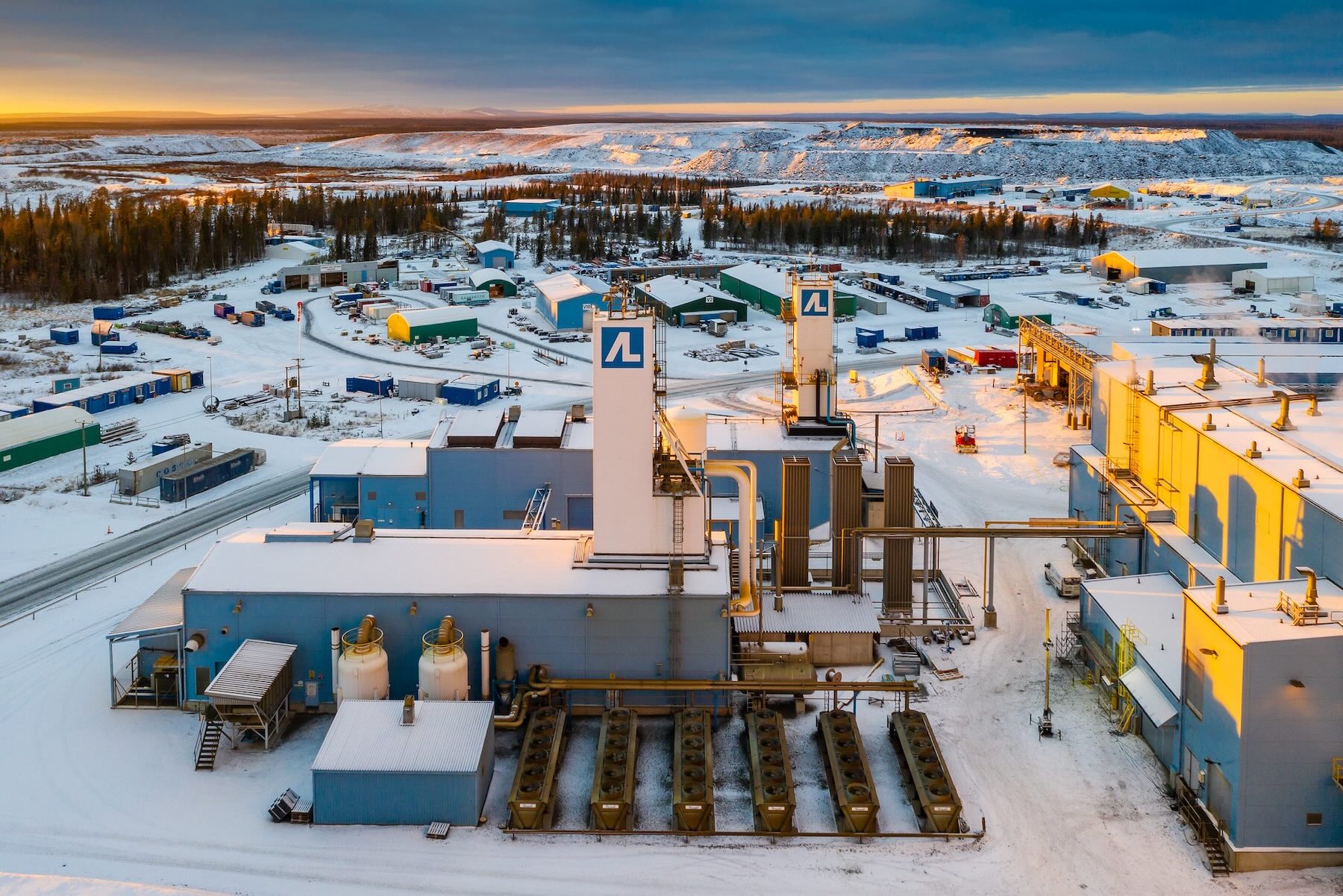
Agnico Eagle Mines Limited (NYSE: AEM) is one of the highest-quality large-cap gold producers, operating primarily in Tier-1 jurisdictions with strong margins, a net cash balance sheet, and industry-leading capital discipline. At a share price of $220.64, the company carries a market capitalization of approximately $110 billion and trades at roughly 15.9x forward earnings.
Unlike smaller producers, the investment case is not based on multiple expansion or operational turnaround. Instead, the opportunity lies in earnings durability and cash flow growth if current gold prices persist. At present levels, the stock appears priced on more conservative, normalized gold assumptions rather than current realized economics.
Current Earnings Power
Over the past twelve months, Agnico Eagle generated:
- Revenue: $11.9 billion
- EBITDA: $8.2 billion
- Operating income: $6.8 billion
- Net income: $4.46 billion
- EPS: $8.86
Profitability is unusually strong for a producer of this scale:
- EBITDA margin: ~69%
- Operating margin: ~57%
- Net margin: ~37%
Free cash flow totaled approximately $4.4 billion, or $8.79 per share, representing a ~37% FCF margin.
These results reflect the impact of higher realized gold prices flowing through a largely fixed cost base.
Operating Leverage to Gold
Gold mining economics are highly sensitive to realized prices. With most operating costs fixed or slow to adjust, incremental price gains translate directly into margins and free cash flow.
At current production levels, each $100 per ounce change in realized gold prices is estimated to move annual operating cash flow by roughly $350–400 million.
This sensitivity is the core of the investment case. If gold prices remain elevated, earnings and free cash flow can continue to expand without any change in production volume or cost structure.
Balance Sheet and Financial Position
Agnico Eagle’s financial position is among the strongest in the sector:
- Cash: $2.87 billion
- Total debt: $321 million
- Net cash: $2.55 billion
- Debt / EBITDA: 0.04x
The company also maintains a current ratio near 2.0 and interest coverage approaching 180x. This balance sheet allows management to fund growth internally, increase shareholder returns, and withstand commodity volatility without financial strain.
Returns and Capital Discipline
The company generates returns on equity of approximately 19.6% and returns on invested capital of about 20.8%, well above its estimated cost of capital near 8%. This spread indicates that incremental investment continues to create economic value rather than simply expanding production.
Capital allocation has historically emphasized organic growth, balance sheet strength, and modest but sustainable shareholder returns.
Valuation and Implied Expectations
At current prices, the stock trades at:
- Forward P/E: ~15.9x
- Forward earnings yield: ~6%
- EV / EBITDA: ~13x
This valuation is not cheap relative to smaller producers, but it reflects the company’s jurisdictional quality, operating consistency, and institutional ownership.
More importantly, the multiple implies that the market expects gold prices to normalize lower over time. If current price levels persist, earnings growth alone could reduce the effective multiple through fundamental compounding.
Upside Framework
If gold prices remain near current levels and operating performance holds steady:
- Free cash flow could remain in the $4–5 billion annual range
- Earnings would continue to compound through margin expansion
- A valuation of 18–20x earnings, consistent with prior bull-cycle multiples for high-quality producers, would imply 30–50% upside
This scenario does not require production growth or cost reductions—only sustained pricing.
Market Positioning
Shares have risen approximately 130% over the past year, reflecting stronger fundamentals and higher gold prices. Despite this performance, the stock’s beta of 0.66 indicates lower volatility than the broader equity market.
Institutional ownership stands near 72%, and short interest remains minimal, consistent with the company’s role as a core portfolio holding rather than a speculative trade.
Investment Conclusion
Agnico Eagle is not a high-beta re-rating story. It is a large-scale, institutional-quality producer offering durable free cash flow and significant earnings leverage to gold prices.
At roughly a 6% forward earnings yield, the stock is priced on normalized assumptions rather than current realized economics. If gold prices remain elevated, earnings growth and cash flow compounding alone could drive meaningful equity appreciation.
Within a gold allocation, Agnico Eagle functions as a core anchor position–a liquid, low-risk vehicle for participating in a sustained higher gold price environment, where incremental price strength translates directly into durable shareholder returns.